Wednesday, March 28, 2012

Logic, Meet Google - Crawling to De-index

Posted by Dr. Pete

Since the Panda update, more and more people are trying to control their Google index and prune out low-quality pages. I’m a firm believer in aggressively managing your own index, but it’s not always easy, and I’m seeing a couple of common mistakes pop up. One mistake is thinking that to de-index a page, you should block the crawl paths. Makes sense, right? If you don’t want a page indexed, why would you want it crawled? Unfortunately, while it sounds logical, it’s also completely wrong. Let’s look at an example…

Scenario: Product Reviews

Let’s pretend we have a decent-sized e-commerce site with 1,000 unique product pages. Those pages look something like this:

1000 product pages (diagram)

Each product page has its own URL, of course, and those URLs are structured as follows:

  • http://www.example.com/product/1
  • http://www.example.com/product/2
  • http://www.example.com/product/3
  • http://www.example.com/product/1000

Now let’s say that each of these product pages links to a review page for that product:

Product pages linking to review pages

These review pages also have their own, unique URLs (tied to the product ID), like so:

  • http://www.example.com/review/1
  • http://www.example.com/review/2
  • http://www.example.com/review/3
  • http://www.example.com/review/1000

Unfortunately, we’ve just spun out 1,000 duplicate pages, as every review page is really only a form and has no unique content. Those review pages have no search value and are just diluting our index. So, we decide it’s time to take action…

The “Fix”, Part 1

We want these pages gone, so we decide to use the META NOINDEX (Meta Robots) tag. Since we really, really want the pages out completely, we also decide to nofollow the review links. Our first attempt at a fix ends up looking something like this:

Product pages with blocked links and NOINDEX'ed review pages

On the surface, it makes sense. Here’s the problem, though – those red arrows are now cut paths, potentially blocking the spiders. If the spiders never go back to the review pages, they’ll never read the NOINDEX and they won’t de-index the pages. Best case, it’ll take a lot longer (and de-indexation already takes too long on large sites).

The Fix, Part 2

Instead, let’s leave the path open (let the link be followed). That way, crawlers will continue to visit the pages, and the duplicate review URLs should gradually disappear:

Product pages with followed links

Keep in mind, this process can still take a while (weeks, in most cases). Monitor your index (with the “site:” operator) daily – you’re looking for a gradual decrease over time. If that’s happening, you’re in good shape. Pro tip: Don’t take any single day’s “site:” count too seriously – it can be unreliable from time to time. Look at the trend over time.

New vs. Existing Sites

I think it’s important to note that this problem only applies to existing sites, where the duplicate URLs have already been indexed. If you’re launching a new site, then putting nofollows on the review links is perfectly reasonable. You may also want to put the nofollows in place down the road, after the bad URLs have been de-indexed. The key is not to do it right away – give the crawlers time to do their job.

301, Rel-canonical, etc.

Although my example used nofollow and META NOINDEX, it applies to any method of blocking an internal link (including outright removal) and any page-based or header-based indexation cue. That includes 301-redirects and canonical tags (rel-canonical). To process those signals, Google has to crawl the pages – if you cut the path before Google can re-crawl, then those signals are never going to do their job.

Don’t Get Ahead of Yourself

It’s natural to want to solve problems quickly (especially when you’re facing  lost traffic and lost revenue), and indexation issues can be very frustrating, but plan well and give the process time. When you block crawl paths before de-indexation signals are processed or try to throw everything but the kitchen sink at a problem (NOINDEX + 301 + canonical + ?), you often create more problems than you solve. Pick the best tool for the job, and give it time to work.

Update: A couple of commenters pointed out that you can use XML sitemaps to encourage Google to recrawl pages with no internal links. That's a good point and one I honestly forgot to mention. While internal links are still more powerful, an XML sitemap with the nofollow'ed (or removed) URLs can help speed the process. This is especially effective when it's not possible to put the URLs back in place (a total redesign, for example).


Sign up for The Moz Top 10, a semimonthly mailer updating you on the top ten hottest pieces of SEO news, tips, and rad links uncovered by the Moz team. Think of it as your exclusive digest of stuff you don't have time to hunt down but want to read!

Source: http://feedproxy.google.com/~r/seomoz/~3/aGljrg6rvxU/logic-meet-google-crawling-to-deindex

peoria il seo peoria illinois seo rockford illinois seo peru illinois seo

The Taylor Swift Guide to Growing a Massive Fan Base

This guest post is by Jennifer Blanchard of InkyBites. If you haven’t heard of Taylor Swift, you’ve probably been living in a cave the last few years. Swift is the teen country sensation who took on the music industry starting at the ripe age of 13, and became one of the biggest musical acts in [...]

Originally at: Blog Tips at ProBlogger
DMS_468x60_LS_banner4.gif

The Taylor Swift Guide to Growing a Massive Fan Base

Source: http://feedproxy.google.com/~r/ProbloggerHelpingBloggersEarnMoney/~3/BztdRrKNKPY/

illinois seo consultants illinois seo agency seo illinois Bloomington illinois seo

Tuesday, March 27, 2012

Adf.ly Review Is It A Good Traffic Source? ( Scam Or Not )?

Thanks for stopping in and reading my review of the adf.ly traffic network.
Keep reading to see what I discovered on this up and coming traffic source, ways to make money with adf.ly? And the results of my adfly traffic campaigns?
I stumbled on some information about this somewhat newly discovered traffic source almost by accident. I [...]

Source: http://jaysonlinereviews.com/http:/jaysonlinereviews.com/adf-ly-review-good-traffic-source-scam/

peru illinois seo bloomington il seo lasalle seo lasalle illinois seo

Internship Advice from an Internship Expert

Source: http://www.walkersands.com/Blog/internship-advice-from-an-internship-expert/

search marketing illinois illinois seo company illinois seo consultants illinois seo agency

Google Instant Answers: Rich Snippets & Poor Webmasters

This is a pretty powerful & instructive image in terms of "where search is headed."

It's a Yahoo! Directory page that was ranking in the Google search results on a Google Android mobile device.

Note the following

  • the page is hosted on Google.com
  • the page disclaims that it is not endorsed by Google
  • the page embeds a Google search box
  • the page strips out the Yahoo! Directory search box
  • the page strips out the Yahoo! Directory PPC ads (on the categories which have them)
  • the page strips out the Yahoo! Directory logo
Recall that when Google ran their bogus sting operation on Bing, Google engineers suggest that Bing was below board for using user clickstreams to potentially influence their search results. That level of outrage & the smear PR campaign look ridiculous when compared against Google's behavior toward the Yahoo! Directory, which is orders of magnitude worse:


Bing vs Google Google vs Yahoo! Directory
editorial Uses user-experience across a wide range of search engines to potentially impact a limited number of search queries in a minor way. Shags expensive hand-created editorial content wholesale & hosts it on Google.com.
hosting Bing hosts Bing search results using Bing snippets. Google hosts Yahoo! Directory results using Yahoo! Directory listing content & keeps all the user data.
attribution Bing publicly claimed for years to be using a user-driven search signal based on query streams. Google removes the Yahoo! Directory logo to format the page. Does Google remove the Google logo from Google.com when formatting for mobile? Nope.
ads Bing sells their own ads & is not scraping Google content wholesale. Google scrapes Yahoo! Directory content wholesale & strips out the sidebar CPC ads.
search box Bing puts their own search box on their own website. Google puts their own search box on the content of the Yahoo! Directory.
user behavior Google claimed that Bing was using "their data" when tracking end user behavior. Google hosts the Yahoo! Directory page, allowing themselves to fully track user behavior, while robbing Yahoo! of the opportunity to even see their own data with how users interact with their own listings.


In the above case the publisher absorbs 100% of the editorial cost & Google absorbs nearly 100% of the benefit (while disclaiming they do not endorse the page they host, wrap in their own search ad, and track user behavior on).

As we move into a search market where the search engines give you a slightly larger listing for marking up your pages with rich snippets, you will see a short term 10% or 20% lift in traffic followed by a 50% or more decline when Google enters your market with "instant answers."

The ads remain up top & the organic resultss get pushed down. It isn't scraping if they get 10 or 20 competitors to do it & then use the aggregate data to launch a competing service ... talk to the bankrupt Yellow Pages companies & ask them how Google has helped to build their businesses.

Update: looks like this has been around for a while...though when I spoke to numerous friends nobody had ever seen it before. The only reason I came across it was seeing a referrer through a new page type from Google & not knowing what the heck it was. Clearly this search option doesn't get much traffic because Google even removes their own ads from their own search results. I am glad to know this isn't something that is widespread, though still surprised it exists at all given that it effectively removes monetization from the publisher & takes the content wholesale and re-publishes it across domain names.

Source: http://www.seobook.com/instant-answers-rich-snippets-poor-webmasters

bloomington il seo lasalle seo lasalle illinois seo morton illinois seo

Focus on The Business Model

Google's Take on Search Plus Your World

A few weeks ago Google announced the launch of Search Plus Your World, which deeply integrates social sites (especially Google+) into the Google search experience to make it more personalized.

While Google claimed that the socialization was rather broad-based, the lack of inclusion of Facebook & Twitter along with the excessive promotion of Google+ raised eyebrows. While the launch was claimed to be social for personalizing results, the Google+ promotions appeared on queries where they were clearly not the most relevant result even when users are not logged into a Google account.

Google+ Over-promotion

A couple weeks ago when Google announced Google Search Plus Your World competitors collectively complained about Google over-promoting their own affiliated websites.

Twitter was perhaps the loudest complainer, highlighting how Google basically eats all the above-the-fold real estate with self promotion on this @WWE search.

It is no surprise that folks like Ben Edelman, Scott Cleland & Fair Search chimed in with complaints, as this is just a continuation of Google's path. But the complaints came from a far wider cast of characters on this move: the mainstream press like CNN, free market evangalists like the Economist, Google worshipers indoctrinated in their culture who wrote a book on Google & even ex-Googlers now call into question Google's transparently self serving nature:

I think Google as an organization has moved on; they’re focussed now on market position, not making the world better. Which makes me sad.

Google is too powerful, too arrogant, too entrenched to be worth our love. Let them defend themselves, I'd rather devote my emotional energy to the upstarts and startups. They deserve our passion.

The FTC's Google antitrust probe is to expand to include a review of Google+ integration in the search results.

Facebook & Twitter launched a don't be evil plugin named Focus On The User, which replaces Google+ promotion with promotion of profiles from Facebook& Twitter.

For the top tier broad social networks framing the idea of integrating promotion of their networks directly in the search results is a natural & desirable conclusion, but is that just a convenient answer to the wrong question?

  • Whether Google ranks any particular organic result above the corresponding Bing ranking in Google's now below-the-fold organic results is a bit irrelevant when the above the fold results are almost entirely Google.com. But is the core problem that we are under-representing social media in the search results? According to Compete.com, Facebook & YouTube combine to capture about 16% of all downstream Google clicks. Do we really need to increase that number until the web has a total of 5 websites on it? What benefit do we get out of a web that is just a couple big walled gardens?
  • If Facebook is already getting something like 20% of US pageviews & users are still looking for information elsewhere, doesn't that indicate that they probably desire something else? Absolutely Facebook should rank for Facebook navigational queries, but given all their notes spam, I don't like seeing them in the search results much more than seeing a site like eHow.
  • The he said / she said data deals are also highly irrelevant. What is really needed is further context. Before Google inserted Google+ in their search results the Google+ social network was far less successful than MySpace (which recently sold for only $35 million). If social media is added as an annotation to other 3rd party listings then I think that has the opportunity to add valuable context, but where a thin "me too" styled social media post replaces the publisher content it lowers the utility of the search results & wastes searcher's time. Further, when those social media results are little more than human-powered content scrapers it also destroys the business models of legitimate online publishers.

Over-promotion vs "Search Spam"

At any point Google can promote one of their new verticals in a prominent location in the search results & if they are anywhere near as good as the market leader eventually they can beat them out of nothing more than the combination of superior search placement, monopoly search marketshare, account bundling & user laziness. What's more, they can make paid products free and/or partner with competitors 2 through x in an attempt to destroy the business model of anyone they couldn't acquire (talk to Groupon).

Amit Singhal is obviously a brilliant guy, but I thought some of the answers he gave during a recent interview by Danny Sullivan were quite evasive & perhaps a bit inauthentic. In particular, ...

  • "The overall takeaway that I have in my mind is that people are judging a product and an overall direction that we have in the first two weeks of a launch, where we are producing a product for the long term." If the product wasn't ready for prime time you were not required to mix it directly into the organic search results right off the bat. It could have been placed at the bottom of the search results, like the "Ask on Google" links were. Bing has been working on social search for 18 months & describes their moves as "being very conservative."
  • "The user feedback we have been getting has been almost the other side of the reaction we’ve seen in the blogosphere." Of course publishers who see their content getting scraped & see the scraped copy outranking the original have a financial incentive to care about a free & automated scraper site displacing their work. They don't get those pageviews, they don't get that referrer data, and they don't get those ad impressions. Google's PR team is anything but impressed when another company dares do that to Google.
  • "The users who have seen this in the wild are liking it, and our initial data analysis is showing the same." Much like the Google Webmaster Tools shows that pages with a +1 in the search results get a higher CTR, this Google+ social stuff also suffers from the same type of sampling bias & giving the listings a larger and more graphical stand out further help them pull in much more clicks. Any form of visual highlighting & listing differentiation can lift CTR. I might be likely to click on some of my own results more, but when I do so you might just be grabbing a slice of navigational searches I was going to do anyway where I was looking for something else I posted on Google+ or my Google+ account or the account of a friend & so on. Further, aggregate data hides many data points that are counter to the general trend. I have seen instances of branded searches where the #1 organic site was getting a CTR above 70% (it even had organic sitelinks, further indicating it was a navigational search) and for such a search in some cases there were 2 Adwords ads above the organic results & then the Google+ page for a brand outranked the associated brand in the SERPs for those who followed it! That is a terrible user experience, particularly since the + page hasn't even had any activity for months.
  • "Every time a real user is getting those results, they really are delighted. Given how personal this product is, you can only judge it based on personal experiences or by aggregate numbers you can observe through click-through." First, publishers are not fake users. Secondly, as mentioned above, there is a sampling bias & the + listings stand out with larger & more graphical listings. If they didn't get a higher CTR that would mean they were *really* irrelevant.
  • "out of the gate, whereas we had limited users to train this system with, I’m actually very happy with the outcome of the personal results." They could have been placed at the bottom of the search results or off to the side or some such until there was greater confidence in the training set.
  • "People are coming to a conclusion about the product today, within the first two weeks, and they’re not fully seeing the potential where we can build this product around real identities and real relationships." If a publisher promotes a site to the top of the search results & then says something like 'we will improve quality later' they are branded as spammers. In the past Google has justified penalizing a site based on its old content that no longer exists on the site. Investing in depth, quality & volume is a cycle. If others get prohibited from evolving through the cycles due to algorithms like Panda then it becomes quite hard to compete as a new start up when Google can just insert whatever it wants right near the top & then work on quality after the fact.
  • "We don’t think of this as a promotional unit now. This is a place that you would find people with real identities who would be interesting for your queries." If this is the case then why does it only promote Google+?
  • "We’re very open to incorporating information from other services, but that needs to be done on terms that wouldn’t change in a short period of time and make our products vanish." The problem is, if a company builds a reputation as a secretive one that clones the work of its partners & customers then people don't want to do open-ended transparent relationships. Naive folks might need to see the blood and tears 3 or 4 times to pick up on the trend, but even the slowest of the slow notice it after a dozen such moves.
  • "I’m just very wary of building a product where the terms can be changed." Considering Google's lack of transparency & self-promotional bias on the social networking front, would you be fully transparent and open with Google? If so, then aren't the search algorithms complex enough that it would make sense to make those transparent as well? How can you ask other social networks to increase transparency at the same time Google is locking down their search data on claims of protecting user privacy?
  • "It’s not just about content. It’s about identity, and when you start talking about these things and what it takes to build this, the data needed is much more than we can publicly crawl." This is where being trustworthy is so crucial. Past interactions with Yelp, TripAdvisor & Groupon likely make future potential partners more risk adverse & cautious. Outrageous "accidents" like those that happened with Mocality & Open Street Map from playing fast and loose further erode credibility. And even when Google hosts the media & has full access to user data they still rank inferior stuff sometimes (like the recent Santorum YouTube cartoon fiasco), even on widely searched core/head keywords.

The big issue is that if people feel the game is rigged they won't have much incentive to share on Google+. I largely only share stuff that is irrelevant to tangentially relevant to our business interests & won't share stuff that is directly relevant, because I don't want to be forced to compete against an inferior version of my own work when the deck is stacked so the inferior version wins simply because it is hosted on Google.

As we move into the information age a lot of physical stores are shutting down. Borders went bust last year. Sears announced the closure of many stores. And many of the people shopping in the physical stores that remain are using cell phones for price comparisons. Given Google's mobile OS share this is another area where they can build trust or burn it. A friend today mentioned how their online prices on Google Product search almost always show a lower price near the header than the lowest price available in the list - sometimes by a substantial margin.

Identity vs Anonymous Contractors

In the past we have mentioned that transparency is often a self-serving & hypocritical policy by those atop power systems who want to limit the power of those whom they aim to control.

When Google was caught promoting illegal drug ads there was no individual who took the blame for it. When the Mocality scraping & the Open Street Map vandalism issues happened, all that we were told was that Google "was mortified" and it was "a contractor." If people who did hit jobs could just place all the blame on "the contractor" then the world would be a pretty crappy place!

Eric Schmidt warned that "If you have something that you don't want anyone to know, maybe you shouldn't be doing it in the first place." That sage advice came from the same Eric Schmidt that blackballed cNet for positing personal information about him. Around the same time Eric offered the above quote, Google was engaged in secret & illegal backdoor deals with direct competitors to harm their own employees.

What happened to Google recruiters who dared to go against the illegal pact? They were fired on the hour:

"Can you get this stopped and let me know why this is happening?" Schmidt wrote.

Google's staffing director responded that the employee who contacted the Apple engineer "will be terminated within the hour."

When Google+ launched they demanded that you use your real name or don't use the product. They later claimed that you can use a nickname on your account as well, but there is a difference between a nickname and pseudonyms.

What is so outrageous about the claims for this need for real identities is that past studies have shown that pseudonymous comments are best & Bruce Schneier highlighted how we lose our individuality if we are under an ever-watchful eye:

Cardinal Richelieu understood the value of surveillance when he famously said, "If one would give me six lines written by the hand of the most honest man, I would find something in them to have him hanged." Watch someone long enough, and you'll find something to arrest -- or just blackmail -- with. Privacy is important because without it, surveillance information will be abused: to peep, to sell to marketers and to spy on political enemies -- whoever they happen to be at the time.

Privacy protects us from abuses by those in power, even if we're doing nothing wrong at the time of surveillance.

In many markets ads and content are blended in a way that is hard to distingush between them. Whenever Google wants to enter they can demand greater transparency to participate (and then use the standard formatted data from that transparency to create a meta-competitor in the market.)

Increasingly Google is placing more of their search data & their webmaster-related functions behind a registration wall. If you are rich & powerful they will sell you the data. If you are the wrong type of webmaster that aggregate data can be used in *exceptionally* personal ways.

User Privacy

Ahead of Google updating their privacy policy Google has directed a large portion of their ad budget toward ads about how they protect users online.

What better way to ensure user privacy than to allow them to register their accounts under psydonyms? The real name policy on Google+ was part of what made Google want to stop providing referrer data for logged in users who search on Google. This has had a knock on effect where other social sites are framing everything, requiring registration to read more of public user generated content & sending outbound traffic through redirects.

Google's new privacy policy allows them to blend your user data from one service into refining the experience (and ads) on another:

If you’re signed into Google, we can do things like suggest search queries – or tailor your search results – based on the interests you’ve expressed in Google+, Gmail, and YouTube. We’ll better understand which version of Pink or Jaguar you’re searching for and get you those results faster.

Google & Facebook's war (against) user privacy is catching media and governmental attention. Microsoft highlighted some of Google's issues in their "putting people first" ad campaign & the blowback has caused Google not only to publish PR-spin "get the facts" styled blog posts, but to launch yet another ad campaign.

EU regulators have asked Google to pause their privacy policy changes.

Bogus Testimonials & Social Payola

Is social media a cleaner signal than links? If search engines put the same weight on social media that they put on links it would get spammed to bits. It won't be long until a firm like Ad.ly offers sponsored Google+ posts.

Some have suggested that you won't be able to buy Google+ followers however Google already includes user pictures on AdWords ads (even when they desire not to be & even when they didn't endorse the product that Google suggests they endorsed). In due time I expect Google will indeed sell followers & other user interactions as ad units (just like Twitter & Facebook do).

Further, celebrities sell Tweets to advertisers. When they are hot their rates go up:

When Ad.ly introduced self-destructing Charlie Sheen to Twitter, he was paid about $50,000 per tweet. It was worth it. Sheen’s tweet for Internships.com generated 95,333 clicks in the first hour and 450,000 clicks in 48 hours, created a worldwide trending topic out of #tigerbloodintern, attracted 82,148 internship applications from 181 countries, and added 1 million additional visits to Internships.com.

Search engines might consider these to be clean signals if those same search engines were not busy buying the manipulation of said "relevancy" signals.

Attention is purchased to create demand. It isn't comfortable to put it this way, but we are trained to obey authority & to like what others like:

The average Facebook user has 130 friends, which equates with four degrees of separation to thousands of people, Mr. Fischer said. Metrics like that led him to believe that if Facebook could figure out a way to capitalize on "social endorsements," it would be like creating a word-of-mouth campaign that could reach millions of people simultaneously. Since the campaigns would come from a friend, they would theoretically be taken more seriously than, say, a TV commercial, he said.

On an individual basis reviews and ratings get faked everywhere. Even stodgy old slow-moving institutions like colleges game their ranking systems.

There recently was a question raised about how Google's rating systems skewed high on the underlying data. Surely Overstock (the same Overstock Google penalized earlier this year) wouldn't promote Google's trusted stores aggressively on their own site if it made their business appear worse than it actually is, thus a positive bias must be baked in to the system.

Entire categories of demand are created by those tied in with power cost shifting to create bubbles. The federal reserve helped spark a real estate bubble with low interest rates. FBI warnings of mortgage fraud were ignored. Consumers were constantly fed propaganda about "real estate only goes up." Then when that bubble popped, the US government bailed out those who caused it & burned trillions of Dollars propping up home prices. The government even bailed out a company that is now shorting the housing market (when that company was about to get bailed out the secretary of treasury leaked that material non-public information to some of his criminal investor buddies).

Does all the above sound circular, conflicting, corrupt & confusing? It should, because that is how power works & comes off as seeming semi-legitimate when acting in illigitimate ways. The perception of reality is warped to create profitable opportunties that are monetized on the way up and the way down.

Millions of kids take drugs that address the symptoms of being a child full of energy, imagination & entusiasm. In some cases they may need them, but in most cases they probably don't. The solution with the highest economic return gets the largest ad budget, even if it only treats symptoms.

Web Scrape Plus+ (Now With More Scraping)

When the +1 button & Google+ launched, Google highlighted how they would use the + button usage as a "relevancy" signal. Google recently started inserting + pages directly into the search results for brands & right from the very start they were using it as a scraper website that would outrank the original content source.

Google used the buy in from their promised relevancy signal to create a badge-based incentivized system which acts as a glorified PageRank funnel to further juice the rankings of these new pages on a domain name that already had a PageRank 10.

I recently read a blog post about how anyone could do the above & the opportunity is open to everyone. But the truth is, I can't state that something will become a relevancy signal that manipulates the search results in order to get buy in. Or, if I did something which actually had the same net effect, Google would likely chop my legs off for promoting a link scheme.

Recently the topic of Google+ as a scraper site came up yet again via Read Write Web & on Hacker News a Googler stated that it was "childish" to place any of the blame on Google!!!!!!

Google determines how much information is shown near each listing & can create "relevancy" signals in ways that things tied to Google get over-represented (look at the +1 count here). When they do that & it destroys other business models *of course* Google deserves 100% of the blame.

Thin Content & Scraper Sites

Remember the whole justification for Panda was that thin content was a poor user experience?

In spite of sites like eHow getting hit, Google is still pre-paying them to upload content to Youtube.

Now that the (non-Google hosted) thin content has been disappeared (and the % of downstream traffic from Google to Youtube has more then doubled in the past year) it is time for Google to take another slice of the search traffic stream with Search Plus Your World:

The Google vs Facebook locked down walled garden contest will retard innovation. As the corporate internet silos grow larger the independent web withers. Them going after each other may leave room for Twitter, but it doesn't leave lots of room is left for others, as the economics of publishing have to work or the publishers die.

Start ups that were on a successful trajectory were killed by Panda:

The startup had been on a roll up until last February when Google altered its ranking algorithm with the release of “Panda.” The changes decimated TeachStreet’s traffic, and the company never quite recovered.

“We lost a lot of our traffic, and overnight we started talking to partners for biz dev, not for acquisition,” he said. However, many of the potential partners wanted to know about an outright acquisition.

About.com was also smoked by Google:

The biggest worry, though, is that the decline of About.com itself may be irreversible. Fewer people are clicking on About ads placed by Google and the site’s own display ads have dropped in value.

The company has attributed this decline in value to Google’s decision last year to downgrade About pages in its search results. With more than 80% of traffic coming from search, the Google denigration was indeed a blow but About’s problems may be rooted in something deeper.

Keep in mind that the reason these websites were hit was that they were claimed to be thin & thus a poor user experience. When the NYT bought About.com one of the top competing bidders was Google!

Now that the "thin content" has been demoted in the search results Google can integrate deep content silos from Google+, like this one:

That is an 8-word Google+ post about how short another blog post is. I like Todd & do like to read his writings, but here Google is clearly favoring the same sort of content they would have torched if it was done on an independent webmaster's website.

How Google has raters view other websites that redirect traffic is based upon those sites having a substantial value add. Clearly in the above example there was nothing added to the interaction beyond sharing a bookmark with a punchy tagline.

If Google wants to use the + notation to pull up that other referenced page then perhaps that can make sense, but to list an 8-word Google+ page in the search results nearly a year after the Panda algorithm is outrageous. This sort of casual mention integration in the search results occurs on expensive keywords as well. Not only do they list your own Google+ posts...

...but they also list them from anyone you follow...

In addition to information pollution, the other big issue here is time. Google wants to make forms more standardized to make filling them out faster & they give regular sermons on the importance of fast search results. Yet when I do a navigational search, Google delivers two AdWords ads, a huge Google+ promotion, and then the navigational search result barely above the fold.*

*Since I thought the above was obnoxious, I renamed our Google+ company page to S_E_O Book to help Google fix their relevancy problems.

Can anyone explain how Google's speed bias is aligned with putting plus junk right at the top, even on brand searches? Yahoo! has been pretty aggressive with putting shopping ads in the search results, but their implementation is still a better user experience than what Google did above.

And Bing offers an even cleaner experience than that.

Due to how Google integrates Google+ in such a parasitic way I see no incentive for participating on their network except when I have something that is outside of my domain of expertise, something that I am not targeting commercially, something that is thin, or something irrelevant to say! That incentive structure combined with Google's photo meme feature will ensure that content marketers will help plenty of people see Star Wars stuff ranking for mortgage loan search queries.

When you own search/navigation you own language. that position can easily be extended into any other direction/market in a way a social graph can not:

"The only technology I’d rather own than Windows would be English," McNealy said. "All of those who use English would have to pay me a couple hundred dollars a year just for the right to speak English. And then I can charge you upgrades when I add new alphabet characters like ‘n’ and ‘t.’ It would be a wonderful business."

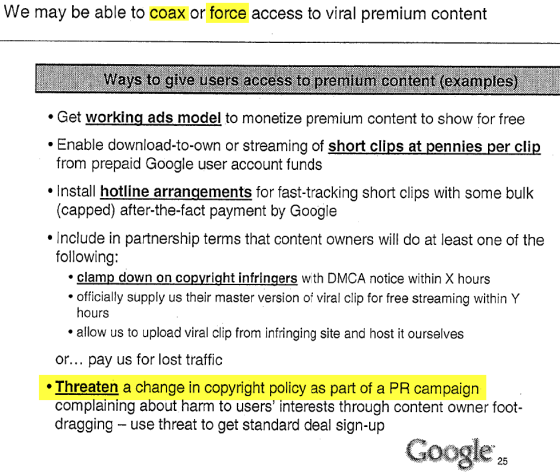
Further, Google can chose at any point to respond to or ignore market regulations in accordance with whatever makes them the most money. They can also fund 3rd parties doing the same (like undermining copyright) to force others to strike an official deal with Google to be "open."

A lot of businesses live on small profit margins, so Google's ability to insert itself & fund criminal 3rd parties aligned with Google's internal longterm interests is a big big big deal. Companies will learn that you either work with Google on Google's terms or you die.

When a public relations issue brews they can quickly change their approach and again position themselves as the white knight.

Brand Equity & Forcing the Brand Buy

Yahoo! put out a research paper highlighting activity bias, stating that the efficacy of online advertising is often over-stated because people who see ads about a topic were already more closely tied in with that particular network & that particular topic before they even saw the ad. As an example, any person who sees an AdWords ad for hemorrhoid treatment was already searching for hemorrhoid-related topics before they saw your ad (thus they were in the subset of individuals that might have came across your site in some way if you were in the search ad ecosystem or not).

This sort of activity bias-driven selection bias (homophily) exists on social networks online & offline.

Google did research on incrementality of ads & they came to the opposite conclusion as Yahoo! did. Google suggested you should buy, buy, buy, even on your own branded keywords. They suggested that testing was expensive (no mention that the only reason it is expensive is because Google chooses not to make such tools easily accessible to advertisers) & that the clicks were so cheap on branded keywords that you should buy, buy, buy. Many advertisers who mix brand & non-brand keywords together don't realize that they are using the "returns" from bidding on their own brand to subsidize over-paying for other keywords.

Google Analytics is the leading & most widely used web analytics program. They can share whatever metrics help them sell more ads (defaulting to crediting the last click for conversions, even if it was on a navigational search to your site) & pull back on features that are not aligned with their business interests (SEO referral data anyone?)

This goes back to Scott McNealy's quote: "The only technology I’d rather own than Windows would be English. All of those who use English would have to pay me a couple hundred dollars a year just for the right to speak English. And then I can charge you upgrades when I add new alphabet characters like ‘n’ and ‘t.’ It would be a wonderful business."

Analysts didn't understand why Google CPC rates were down 8% last quarter while overall search clicks were up 34%. The biggest single reason was likely more clicks on adlinks on branded AdWords ads. While a brand buying its own keyword typically pays far less per click than what some of the biggest keywords go for, the branded keywords typically have an exceptionally high CTR. Those additional clicks dragged down Google's average CPC, but the extra revenue they offered was a big par of the reason why Google was about to grow at 25% even though their display network only grew at 15%.

That slow growth of display is in spite of Youtube now serving over 4 billion video streams per day & Google adding display ads to log out pages.

Online views are not the same as TV views. A comScore study found that 31% of display ads are never seen. In spite of that, US online advertising will reach nearly $40 billion this year.

Google wants to insert itself as a needed cost of business in the same way credit card companies have.

On Google Maps they put an ad inside your location box.

Even if most people don't participate on Google+, Google can still force advertiser buy in through over-promotion of the network in the search results. On your branded keywords they may drive your organic listing below the fold & put Google+ front & center.

Facebook earnings are still growing much faster than Google's & Facebook encourages advertisers to advertise their Facebook pages, so even when you pay for the click Facebook still keeps the user. Facebook is adding apps to the timeline & is trying to win VEVO music video hosting from YouTube.

While Google is primarily known as a search company, it is getting harder to get off of Google though any channel other than a toll booth. Google keeps driving the organic search results downward, while Google verticals fill up many of the organic results that remain. Many companies already buy Google ads on their own YouTube content. Some buy ads on Google to drive them to their Youtube videos & then buy ads on their own Youtube video to promote their websites. Soon Google will try to push you to buy them on your Google+ page as well. Google is becoming a walled garden:

Google wants to control more elements of your social world now. They don’t just want to be a search engine.

Is that so bad? Maybe not. It’s certainly no different from how other companies, from AOL, to Microsoft, to Apple, to Disney, to Facebook, have viewed the world — as ideally a walled garden, an all-consuming platform that most people use for pretty much every form of entertainment and social interaction.

A lot of people thought that Google was somehow different. They were, of course, wrong.
...
To move forward either as the old Google or Google+, Google needs to be capable of making fair deals with the partner ecosystem. It needs to curb its instinct to kill competing media companies that were actually producing great content that Google helped you find.

I suspect there will be plenty of bloodshed before Google figures that one out.

"This is the path we’re headed down – a single unified, ‘beautiful’ product across everything. If you don’t get that, then you should probably work somewhere else." - Larry Page

Google no longer believes in the concept of the open web. Blame it on Larry Page becoming the CEO, blame it on him talking to Steve Jobs & Steve telling him to make fewer and tighter products, blame it on Google funding eHow, or blame it on basically anything. But if you go back far enough, much of the stuff that is going on now was clearly envisioned a decade ago:

I was lucky enough to chat with Larry one-to- one about his expectations for Google back in 2002. He laid out far-reaching views that had nothing to do with short-term revenue goals, but raised questions about how Google would anticipate the day sensors and memory became so cheap that individuals would record every moment of their lives. He wondered how Google could become like a better version of the RIAA - not just a mediator of digital music licensing - but a marketplace for fair distribution of all forms of digitized content. I left that meeting with a sense that Larry was thinking far more deeply about the future than I was, and I was convinced he would play a large role in shaping it. I would rather jump on board that bullet train than ride a local that never missed a revenue stop but never." - Douglas Edwards

What happens when the Google+ version of your content outranks the version on your own site? And what happens when your branded channel and/or your fans become a vertical ad silo Google sells to your competitors?

I tested submitting a couple posts to Google+ with a Wordtracker top keywords list & valuable keywords (on a cpc*traffic) basis in posts about top keywords. Those posts rank #2 or #3 in Google for many people that follows me. No harm to me since those posts were irrelevant to this site, but if they were about my theme & topic I just would have out-competed myself. When Google outranks you (even with a copy of your content) they get to taste the data again and sell off the attention another time. You only get a slice of that monetization, even when it is your work that is being monetized. Maybe it is great for stuff that is somewhat less relevant and/or keywords that are so competitive that you otherwise wouldn't score for them, but we have to be really careful we don't out-compete ourselves. Though if Googke keeps this up they won't be the only ones monetizing it. Give it a few months and celebrities will be selling sponsored Google+ posts based on some metric created by multiplying search volume, CPC & how many followers they have.

Is Bing Better? Will Enough People Ask That Question to Matter?

For years Google built their reputation as being the search engine that offered the cleanest & fastest search results. They were known for monetizing less aggressively than the competition. But over the past couple years Google has dialed up their ads to where they now send a greater ratio of ad traffic than organic search traffic. One Google engineer recently described the ability to rank highly in Google without buying their ads as being a bug that was getting fixed!

Google's big risk in their coupling of aggressive monetization, aggressive self-promotion & changing how users feel about user privacy is that they can create the perception that users should go elsewhere for for an honest or trustworthy search. This not only builds momentum for smaller search services like DuckDuckGo & Blekko, but has also won praise for Bing from Gizmodo, Dave Winer & The Next Web.

Categories: 

Source: http://www.seobook.com/focus

search marketing illinois illinois seo company illinois seo consultants illinois seo agency

Get More Comments: How Honesty Compels Readers to Comment

There’s one technique for soliciting comments that hasn’t been covered explicitly this week, although we’ve shown it through each of the posts we’ve published in this series. What is that technique? Being honest. When we approached the bloggers who wrote posts for the series, we told them we really wanted to hear their favorite technique [...]

Originally at: Blog Tips at ProBlogger
DMS_468x60_LS_banner4.gif

Get More Comments: How Honesty Compels Readers to Comment

Source: http://feedproxy.google.com/~r/ProbloggerHelpingBloggersEarnMoney/~3/7H2bzzgIVAI/

rockford illinois seo peru illinois seo bloomington il seo lasalle seo

How To Be A Super Affiliate And What It Takes To Succeed Online?

How To Be A Super Affiliate And The Characteristics You Will Need Too Succeed Online?
How A Super Affiliate Is Born?
You wake up one morning with a burning desire too better yourself perhaps you just hate your 9 to 5 job, or perhaps you are just trying to make some extra money working from home . [...]

Source: http://jaysonlinereviews.com/http:/jaysonlinereviews.com/super-affiliate-takes-succeed-online/

bloomington il seo lasalle seo lasalle illinois seo morton illinois seo

Google Announces 40 Search Updates in February

The Google search blog announced 40 search updates that are happening this month. From the Google Blog… This month we have many improvements to celebrate. With 40 changes reported, that marks a new record for our monthly series on search quality. Most of the updates rolled out earlier this month, and a handful are actually [...]

Source: http://www.legalsearchmarketing.com/general-search-engine-news/google-announces-40-search-updates-in-february/

lasalle seo lasalle illinois seo morton illinois seo search marketing illinois

Search Engine Optimisation London Tips to Connect to Customers with Content

Any search engine optimization London expert will tell you that web copy-writing and content marketing are the major pillars of connecting with the host of customers present online. Without such features in your SEO campaign you will not only have a poor search ranking but the website will look static to the online visitors. With [...]

Source: http://feedproxy.google.com/~r/WebsudasaBlog/~3/MNCTleUkot8/

peoria il seo peoria illinois seo rockford illinois seo peru illinois seo

Monday, March 26, 2012

Rent Or Buy Video Games Online And Make Affiliate Cash At The Same Time?

Rent Or Buy Video Games Online @ Make Affiliate Cash At Same Time?
Register for GameFly™ Game Rentals – Start for Free!
Redbox put a lot of your local mom and pop video rental places out of business because it all boils down to price, and convenience in the end.
Customers want a great price, and convenience. If [...]

Source: http://jaysonlinereviews.com/http:/jaysonlinereviews.com/rent-or-buy-video-games-online-make-affiliate-cash-at-same-time/

lasalle seo lasalle illinois seo morton illinois seo search marketing illinois

Advantages Of SEO: Chicago Companies Are Seeing Great Results

According to a recent survey, the cost per lead for Chicago inbound marketing was 60% lower than the cost for an outbound lead. Inbound marketing was a fledgling marketing technique just a few years ago; now it has been proven more effective than some of the oldest promotion techniques. SEO in Chicago is synonymous with [...]

Source: http://www.designandpromote.com/advantages-of-seo-chicago-companies-are-seeing-great-results/

peoria illinois seo rockford illinois seo peru illinois seo bloomington il seo

Simplicity and Speed


Don't let this happen to you: "retail space for lease."

Another failed business. I can guess two things they may have done wrong, that business that used to be here. They may have had a problem keeping things simple and doing things with tremendous velocity.

Simplicity and speed. Keep things simple and easy for your customers or clients, start and finish projects quickly, without sacrificing quality, do these two things, and you'll stand out from your competitors.

You will seem extraordinary. Smarter. More sophisticated. More adept at what you do. Doing it fast is perceived as doing it with better understanding. You know exactly what to do, you do it, you're done.

Simplicity and speed.

When selling your services, stress simplicity and speed, assuming your company and product are first rate.

You should be selling only what you honestly feel to be the very best in the field. If you're selling yourself, as a consultant, freelancer, or outside contractor, then you are the product. Make yourself be the best product available: keep improving and expanding and enhancing what you do.

The best products are easy to use and give desired results quickly. They are fun to use and they get the job done swiftly. No problem. Like lightning. Simplicity and speed.

Your clients, once they realize the severity and urgency of the problem that your services solve, will want a remedy in a big hurry. They don't want to sign the contract, hand you a check, then sit around waiting for something to happen. Days go by. Weeks maybe. Still: nothing.

Keep it uncomplicated. Do it fast. Simplicity and speed.

Make your client feel relaxed, happy, confident in your professionalism, which is proven by your simplicity and speed. They turn the problem over to you, and aside from a few minor modifications or the distribution of material explaining new procedures and goals, the client does nothing. You take care of it all.

"Once you sign these papers, after looking over them, we'll get started on it right away."

Say those exact words, especially "right away."

"Right away" is breathtaking, it sweeps you off your feet, it's a magic carpet ride, off you go into the wild blue yonder -- snap! The program is up and running.

"...and best of all, we can get the basics all lined up immediately."

The client will know you don't mean "instantly" or "right this very second." You will be understood to mean by "immediately" something like within a few hours after returning to your office. If you're really organized and disciplined, barring any unexpected intrusions or interruptions, you'll get on their project within minutes of arriving at your place of business.

You'll send the client an email, letting them know you've already begun, and as you wade into these new waters, some questions and concerns arose, and now you'd like to present these issues to the client, and get a response to each one of them.

Create the impression, credible because it's true, that you are such a seasoned expert, you can get the project done with astonishing speed. Your client will consider you to be smarter than the other fellows or gals. You'll stand out as the super professional expert with all the right information and smooth moves.

Even if you must ask the client to participate on some level, don't make it sound like more work, yet another load to bear. Make it seem like something he'd demand to be allowed to do, and you are going to be gracious enough to read his mind and deliver this opportunity to him.

"Mr. Client, since I know you'll want to optimize the effectiveness and maximize the results of this program, I look forward to your limited, sporadic participation, to set a good example for your staff, and get a feel for what to expect out of your people. By experiencing the system, spending a few moments engaged in the process, you'll understand it better, from the inside out. That intimate understanding will automatically cause you to be more authoritative in regard to its value and importance."

Words like "limited", "sporadic", "good example", "experiencing", "understand", "intimate", "automatically", "more authoritative" are used to both convey the reality of the situation, and at the same time, soften it so it doesn't seem so abrupt, disruptive, or uncomfortable.

You come up with a more targeted set of words for your own sales situation.

But you get the idea.

Avoid all negative words when asking for action, emphasize opportunity and normal operational assumptions ("you'll want to set a good example for your staff" and "you'll gain a more intimate understanding of how the process works"), and make the client understand that you will be handling the lion's share of the responsibilities and work.

The client should want to have direct experience with the process being implemented. There is no better way to understand it. He or she will then come up with their own words to explain and describe the project's inner workings. No memorization of any script is necessary. The client crafts an individualized narrative, based on personal involvement.

This experiential knowledge could come in handy when talking about it with the press, employees, family, friends, peers, colleagues, and the board of directors.

How foolish we look when a deep question is asked about methodology and we stumble around, unable to answer because we delegated the process and didn't see any reason to know the nitty-gritty details. At least a limited, sporadic engagement with the process provides a general orientation to the thorny, super specific query.

You can't just sell something.

You have to help the client come up with their own story about why your service is the ideal way to solve a problem the client may not have been aware of having. The client must explain what the problem is, why it's serious and needs immediate attention, and why you are the one to do it.

In some cases, getting the client directly engaged with the process is not possible.

You must provide the client with the correct words to use to defend and explain his or her decision to trust you and pay you money to provide them with something. You can't just let them wing it. You can't assume they can communicate clearly all the benefits and rationale for purchasing from you.
You must coach your client on how to describe what you're doing for them, why it's mandatory and urgent, and how you are going to deliver the needed solution -- with the utmost in simplicity and the greatest of speed. Simplicity and speed.

Drill that into your mind and the mentality of the corporation.

Simplicity and speed.

These two qualities will set you apart from other persuaders.

This will make you look vastly more professional.

Now live up to this high regard by actually being the best in the business. Be sure you really are fast, professional, expert, and happy to be providing a valuable service at a fair price to those who genuinely need and want it.

Let your competitors remain complicated and sluggish. Problematic and slow. Unresponsive and procrastinating.

You use the secret weapons of simplicity and speed.

.


Source: http://pluperfecter.blogspot.com/2012/02/simplicity-and-speed.html

illinois seo consultants illinois seo agency seo illinois Bloomington illinois seo

Schwarzkopf/Got2b Launch New Products

On Tuesday night I popped along to fab London bar Circus for a party hosted by Schwarzkopf and Got2b. Did you know that Schwarzkopf is the UK’s biggest selling hair dye brand. Me neither! At the event they announced the launch of more of their foam dyes – this time in lighter shades and also [...]

Source: http://feedproxy.google.com/~r/JCulture/~3/sdHsHGLX2RA/schwarzkopfgot2b-launch-new-products.html

illinois seo consultants illinois seo agency seo illinois Bloomington illinois seo

Interview of Jonah Stein

I was recently chatting with Jonah Stein about Panda & we decided it probably made sense to do a full on interview.

You mentioned that you had a couple customers that were hit by Panda. What sort of impact did that have on those websites?

Both of these sites saw an immediate hit of about 35% of google traffic. Ranking dropped 3-7 spots. The traffic hit was across the board, especially in the case of GreatSchools, who saw all content types hit (school profile pages, editorial content, UGC)

GreatSchools was hit on the 4-9 (panda 2.0) update and called out in the Sistrix analysis.

How hard has GreatSchools been hit? Sistrix data suggested that GreatSchools was loosing about 56% of Google traffic. The real answer is that organic Google-referred traffic to the site fell 30% on April 11 (week over week) and overall site entries are down 16%. Total page views are down 13%. The penalty, of course, is a “site wide” penalty but not all entry page types are being affected equally

Google suggested that there was perhaps some false positives but that they were generally pretty satisfied with the algorithms. For sites that were hit, how do clients respond to the SEOs? I mean did the SEO get a lot of the blame or did the clients get that the change was sort of a massive black swan?

I think I actually took it harder then they did. Sure, it hit their bottom line pretty hard, but it hit my ego. Getting paid is important but the real rush for me is ranking #1.

Fortunately none of my clients think they are inherently entitled to Google traffic, so I didn't get blamed. They were happy that I was on top of it (telling them before they noticed) and primarily wanted to know what Panda was about.

Once you get over the initial shock and the grieving, responding to Panda was a rorschach test, everyone saw something different. But is also an interesting self - reflection, especially when the initial advice coming from Greg Boser and a few others was to start to de-index content.

For clients who are not ad driven, the other interesting aspect is that generally speaking conversions were not hurt as much as traffic, so once you start focusing on the bottom line you discover the pain is a little less severe than it seemed initially.

So you mentioned that not all pages were impacted equally. I think pages where there was more competition were generally hit harder than pages that had less competition. Is that sort of inline with what you saw?

Originally I thought that was maybe the case, but as I looked at the data during the recovery process I became convinced that Panda is really the public face of a much deeper switch towards user engagement. While the Panda score is sitewide the engagement "penalty" or weighting effect on also occurs at the individual page. The pages or content areas that were hurt less by Panda seem to be the ones that were not also being hurt by the engagement issue.

On one of my clients we moved a couple sections to sub-domains, following the HubPages example and the experience of some members of your community. The interesting thing is that we moved the blog from /blog to blog.domain.com and we moved one vertical niche from /vertical-kw to vertical-kw.example.com. The vertical almost immediately recovered to pre-panda levels while the traffic to the blog stayed flat.

So the vertical was suddenly getting 2x the traffic. On the next panda push the vertical dropped 20% but that was still a huge improvement over before we moved to the subdomain. The blog didn't budge.

The primary domain also seemed to improve some, but it was hard to isolate that from the impact of all of the other changes, improvements and content consolidation we were doing.

After the next panda data push did not kill the vertical sub domain, we elected to move a second one. On the next data push, everything recovered - a clean bill of health - no pandalization at all.

but....

GreatSchools completely recovered the same day and that was November 11th, so Panda 3.0. I cannot isolate the impact of any particular change versus Google tweaking the algorithm and I think both sites were potentially edge cases for Panda anyway.

Now that we are in 3.3 or whatever the numbering calls it, I can say with confidence that moving "bad" content to a sub-domain carries the Panda score with it and you won't get any significant recovery.

You mentioned Greg Boser suggesting deindexing & doing some consolidation. Outside of canonicalization, did you test doing massive deindexing (or were subdomains your main means of testing isolation)?

We definitely collapse a lot of content, mostly 301s but maybe 25% of it was just de-indexing. That was the first response. We took 1150 categories/keyword focused landing pages and reduced to maybe 300. We did see some gains but nothing that resembled the huge boost when Panda was lifted.

Back to the rorschach test: We did a lot of improvements that yielded incremental gains but were still weighed down. I reminds me of when I used to work on cars. I had this old Audi 100 that was running poorly so I did a complete tune up, new wires, plugs, etc., but it was still running badly. Then I noticed the jet in the carburetor was mis-aligned. As soon as I fixed that, boom, the car was running great. Everything else we fixed may have been the right thing to do for SEO and/or users but it didn't solve the problem we were experiencing.

The other interesting thing is that I had a 3rd client who appeared to get hit by Panda or at least suffer from Panda like symptoms after their host went down for about 9 hours. Rankings tanked across the board, traffic down 50% for 10 days. They fully recovered on the next panda push. My theory is that this outage pushed their engagement metrics over the edge somehow. Of course, it may not have really been Panda at all but the ranking reports and traffic drops felt like Panda. The timing was after November 11th, so it was a more recent version of the Panda infrastructure.

Panda 1.0 was clearly a rush job and 2.0 seemed to be a response to the issues it created and the fact that demand media got a free pass. I think it took 6-8 months for them to really get the infrastructure robust.

My takeaways from Panda are that this is not an individual change or something with a magic bullet solution. Panda is clearly based on data about the user interacting with the SERP (Bounce, Pogo Sticking), time on site, page views, etc., but it is not something you can easily reduce to 1 number or a short set of recommendations. To address a site that has been Pandalized requires you to isolate the "best content" based on your user engagement and try to improve that.

I don't know if it was intentional or not but engagement as a relevancy factor winds up punishing sites who have built links and traffic through link bait and infographics because by definition these users have a very high bounce rate and a relatively low time on site. Look at the behavioral metrics in GA; if your content has 50% of people spending less than 10 seconds, that may be a problem or that may be normal. The key is to look below that top graph and see if you have a bell curve or if the next largest segment is the 11-30 second crowd.

I also think Panda is rewarding sites that have a diversified traffic stream. The higher percentage of your users who are coming direct or searching for you by name (brand) or visiting you from social the more likely Google is to see your content as high quality. Think of this from the engine's point of view instead of the site owner. Algorithmic relevancy was enough until we all learned to game that, then came links as a vote of trust. While everyone was looking at social and talking about likes as the new links they jumped ahead to the big data solution and baked an algorithm that tries to measure interaction of users as a whole with your site. The more time people spend on your site, the more ways they find it aside from organic search, the more they search for you by name, the more Google is confident you are a good site.

Based on that, are there some sites that you think have absolutely no chance of recovery? In some cases did getting hit by Panda cause sites to show even worse user metrics? (there was a guy named walkman on WebmasterWorld who suggested that some sites that had "size 13 shoe out of stock" might no longer rank for the head keywords but would rank for the "size 13" related queries.

I certainly think that if you have a IYP and you have been hit with Panda your toast unless you find a way to get huge amounts of fresh content (yelp). I don't think the size 13 shoe site has a chance but it is not about Panda. Google is about to roll out lots of semantic search changes and the only way ecommerce sites (outside of the 10 or so brands that dominate Google Products) will have a chance is with schema.org markup and Google's next generation search. The truth is the results for a search for shoes by size is a miserable experience at the moment. I wear size 16 EEEE, so I have a certain amount of expertise on this topic. :)

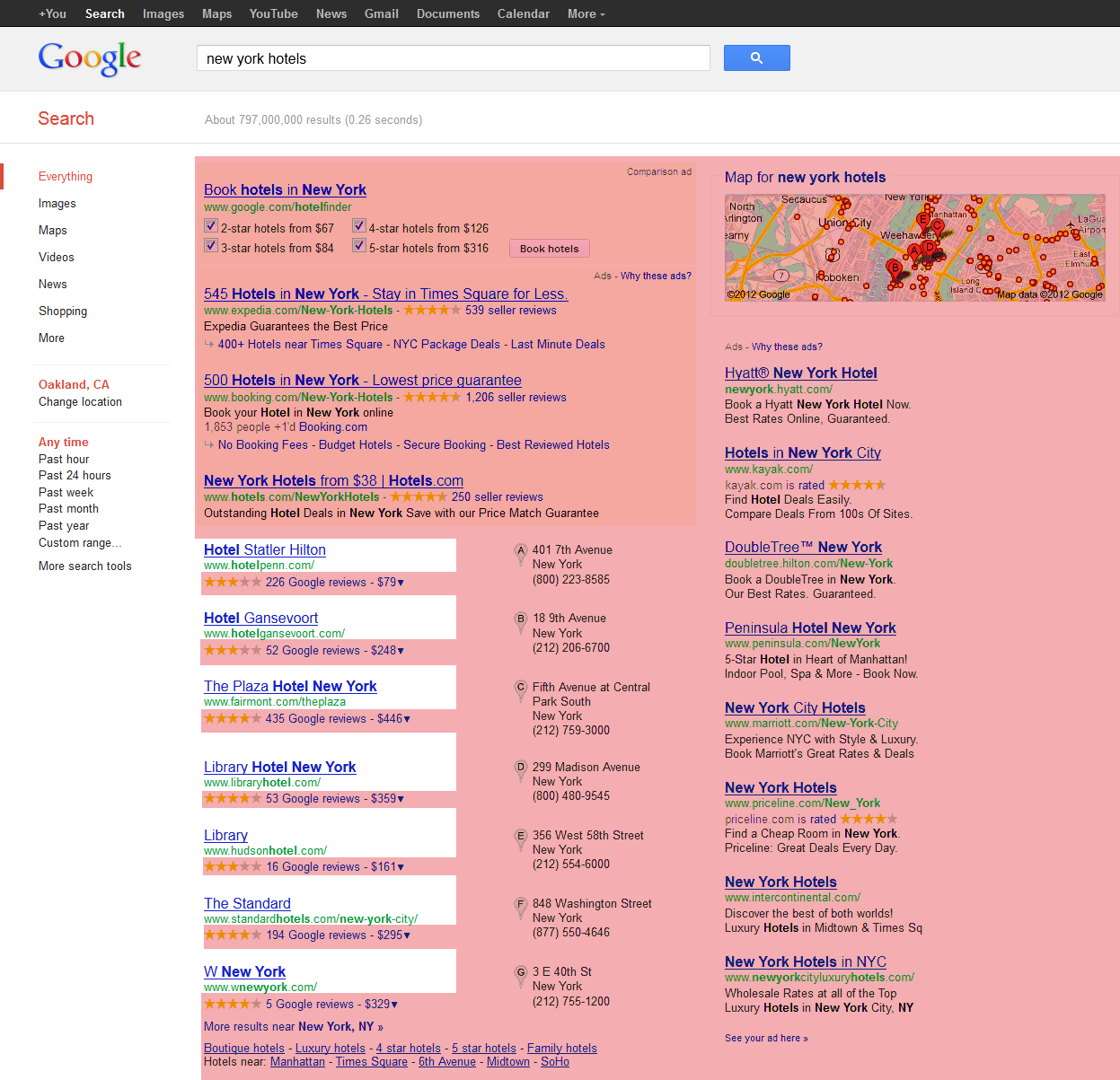
Do you see Schema as a real chance for small players? Or something that is a short term carrot before they get beat with the stick? I look at hotel search results like & and I fear that spreading as more people format their content in a format that is easy to scrape & displace. (For illustration purposes, in the below image, the areas in red are clicks that Google is paid for or clicks to fraternal Google pages.)

I doubt small players will be able to use Schema as a lifeline but it may keep you in the game long enough to transition into being a brand. The reason I have taken your advice about brands to heart and preach it to my clients is that it is short sighted to believe that any of the SEO niche strategies are going to survive if they are not supported with PR, social, PPC and display.

More importantly, however, is that they are going to focus on meeting the needs of the user as opposed to simply converting them during that visit. To use a baseball analogy, we have spent 15 years keeping score of home runs while the companies that are winning the game have been tracking walks, singles, doubles and outs. Schema may deliver some short term opportunities for traffic but I don't think size13shoes.com will be saved by the magic of semantic markup.

On the other hand, if I were running an ecommerce store, particularly if I was competing with Amazon, Bestbuy, Walmart and the hand full of giant brands that dominate the product listings in the SERP, I wouldn't bury my head in the sand and pretend that everyone else wasn't moving in that direction anyway. Maybe if you can do it right you can emerge as a winner, at least over the short and medium term.

In that sense SEO is a moving target, where "best practices" depend on the timing in the marketplace, the site you are applying the strategy to, and the cost of implementation.

Absolutely...but that is only half the story. If you are an entrepreneur who likes to build site based on a monetization strategy, then it is a moving target where you always have to keep your eyes on the horizon. For most of my clients the name of the game is actually to focus on trying to own your keyword space and take advantage of inertia. That is to say that if you understand the keywords you want to target, develop a strategy for them and then go out and be a solid brand, you will eventually win. Most of my clients rank in the top couple of spots for the key terms for their industry with a fairly conservative slow and steady strategy, but I wouldn't accept a new client who comes to me and says they want to rank a new site #1 for credit cards or debt consolidation and they have $200,000 to spend..or even $2,000,000. We may able to get there for the short term but not with strategies that will stand the test of time.

Of course, as I illustrated with the Nuts.com example on SearchEngineLand last month, the same strategy that works on a 14 year old domain may not be as effective for a newer site, even if you 301 that old domain. SEO is an art, not a science. As practitioners we need to constantly be following the latest developments but the real skill is in knowing when to apply them and how much; even then occasionally the results are surprising, disappointing or both.

I think there is a bit of a chicken vs egg problem there then if a company can't access a strong SEO without already having both significant capital & a bit of traction in the marketplace. As Google keeps making SEO more complex & more expensive do you think that will drive a lot of small players out of the market?

I think it has already happened. It isn't about the inability to access a strong SEO it is that anyone with integrity is going to lay out the obstacles they face. Time and time again we see opportunity for creativity to triumph but the odds are really stacked against you if you are an underfunded retailer.

Just last year I helped a client with 450 domains who had been hit with Panda and then with a landing page penalty. It took a few months to sort out and get the reconsideration granted (by instituting cross domain rel=canonical and eliminating all the duplicate content across their network). They are gradually recovering to maybe 80% of where they were before Panda 2.0 but I can't provide them an organic link building strategy that will lift 450 niche ecommerce sites. I can't tell them how they are going to get any placement in a shrinking organic SERP dominated by Google's dogfood, shopping results from big box retailers and enormous Adwords Product Listings with images

From that perspective, if your funding is limited, do you think you are better off attacking a market from an editorial perspective & bolting on commerce after you build momentum (rather than starting with ecommerce and then trying to bolt on editorial?

Absolutely. Clearly the path is to have built Pinterest, but seriously...

if you are passionate about something or have a disruptive idea you will succeed (or maybe fail), but if you think you can copy what others are doing and carve out a niche based on exploits I disagree. Of course, autoinsurancequoteeasy.com seems to be saying you can still make a ton of money in the quick flip world, even with a big bank roll, you need to be disruptive or innovative.

On the other hand, if you have some success in your niche you can use creativity to grow, but it has to be something new. Widget bait launched @oatmeal's online dating site but it is more likely to bury you now than help you rank #1, or at least prevent you from ranking on the matching anchor text.

When a company starts off small & editorially focused how do you know that it is time to scale up on monetization? Like if I had a successful 200 page site & wanted to add a 20,000 page database to it...would you advise against that, or how would you suggest doing that in a post-Panda world?

This is a tough call. I actually have a client in exactly this position. I guess it depends on the nature of the 20,000 pages. If you are running a niche directory (like my client) my advice to them was to add the pages to the site but no index the individual listing until they can get some unique content. This is still likely to run fowl of the engagement issue presented by Panda, so we kept the expanded pages on geo oriented sub-domains.

Earlier you mentioned that Panda challenged some of your assumptions. Could you describe how it changed your views on search?

I always tell prospects that 10-15 years ago my job was to trick search engines into delivering traffic but over the last 5-6 years it has evolved and now my job is to trick clients into developing content that users want. Panda just changed the definition of "good content" from relevant, well linked content to relevant, well linked, sticky content.

It has also made me more of a believer in diversifying traffic.

Last year Google made a huge stink about MSN "stealing" results because they were sniffing traffic streams and crawling queries on Google. The truth is that Google has so many data sources and so many signals to analyze that they don't need to crawl facebook or index links on twitter. They know where traffic is coming from and where it is going and if you are getting traffic from social, they know it.

As Google folds more data into their mix do you worry that SEO will one day become too complex to analyze (or move the needle)? Would that push SEOs to mostly work in house at bigger companies, or would being an SEO become more akin to being a public relations & media relations expert?

I think it may already be too complex to analyze in the sense that it is almost impossible to get repeatable results for every client or tell them how much traffic they are going to achieve. On the other hand, moving the needles is still reasonably easy—as long as you are in agreement about what direction everyone is going. SEO for me is about Website Optimization, about asking everyone about the search intent of the query that brings the visitors to the site and making sure we have actions that match this intent. Most of my engagements wind up being a combination of technical seo/problem solving, analytics, strategy and company wide or at least team wide education. All of these elements are driven by keyword research and are geared towards delivering traffic so it is an SEO based methodology, but the requirements for the job have morphed.

As for moving in house, I have been there and I doubt I will ever go back. Likewise, I am not really a PR or media relations expert but if the client doesn't have those skills in house I strongly suggest they invest in getting them.

Ironically, many companies still fail to get the basics right. They don't empower their team, they don't leverage their real world relationships and most importantly they don't invest enough in developing high quality content. Writing sales copy is not something you should outsource to college students!

It still amazes me how hard it is to get content from clients and how often this task is delegated to whoever is at the bottom of the org chart. Changing a few words on a page can pay huge dividends but the highest paid people in the room are rarely involved enough.

In the enterprise, SEO success is largely driven by getting everyone on board. Being a successful SEO consultant (as opposed to running your own sites) is actually one quarter about being a subject matter expert on everything related to Google, one quarter about social, PR, Link building, conversion, etc and half about being a project manager. You need to get buying from all the stake holders, strive to educate the whole team and hit deliverables.

Given the increased complexity of SEO (in needing to understand user intent, fixing a variety of symptoms to dig to the core of a problem, understanding web analytics data, faster algorithm changes, etc.) is there still a sweet spot for independent consultants who do not want to get bogged down by those who won't fully take on their advice? And what are some of your best strategies for building buy in from various stakeholders at larger companies?

The key is to charge enough and to work on a monthly retainer instead of hourly. This sounds flippant but the bottom line is to balance how many engagements you can manage at one time versus how much you want to earn every month. You can't do justice to the needs of a client and bill hourly. That creates an artificial barrier between you and their team. All of my clients know I am always available to answer any SEO related question from anyone on the team at almost any time.

The increased complexity is really job security. Most of my clients are long term relationships and the ones I enjoy the most are more or less permanent partnerships. We have been very successful together and they value having me around for strategic advice, to keep them abreast of changes and to be available when changes happen. Both of the clients who got hit by Panda have been with me for more than four years.

No one can be an expert in everything. I definitely enjoy analytics and data but I have very strong partnerships with a few other agencies that I bring in when I need them. I am very happy with the work that AnalyticsPros has done for my clients. Likewise David Rodnitzky (PPC Associates) and I have partnered on a number of clients. Both allow me to be involved in the strategy and know that the execution will be very high quality. I only wish I had some link builders I felt as passionate about (given that Deborah Mastaler is always too busy to take my clients.)

You mentioned that you thought user engagement metrics were a big part of Panda based on analytics data & such...how would a person look through analytics data to uncover such trends?

I would focus on the behavioral metrics tab in GA. It is pretty normal to have a large percentage of visitors leave before 10 seconds, but after that you should see a bell curve. Low quality content will actually have 60-70% abandonment in less than 10 seconds, but the trick is for some searches 10 seconds is a good result: weather, what is your address, hours of operations. Lots of users get what they need from searches, sometimes even from the SERP, so look for outliers. Compare different sections of your site, say the blog or those infographics & bad page types.

Its hard to say until you get your hands in the data but if you assume that individual pages can be weighed down by poor engagement and that this trend is maybe 1 year old and evolving, you can find some clues. Learn to use those advance segments and build out meaningful segmentation on your dashboard and you will be surprised how much of this will jump out at you. It is like over optimization: until you believed in it you never noticed & now you can spot it within a few seconds of looking at a page. I won't pretend engagement issues jump out that fast but it is possible to find them, especially if you are an in house SEO who really knows your site.

The other important consideration is that improving engagement for an given page is a win regardless of whether it impacts your rankings or your Panda situation. The mantra about doing what is right for the users, not the search engine may sound cliche but they reality is that most of your decisions and priorities should be driven by giving the user what they want. I won't pretend that this is the short road to SERP dominance but my philosophy is to target the user with 80% of your efforts and feed the engines with the other 20.

Thanks Jonah :)

~~~~~~~~~~

Jonah Stein has 15 years of online marketing experience and is the founder of ItsTheROI, a San Francisco Search Engine Marketing Company that specializes in ROI driven SEO and PPC initiatives. Jonah has spoken at numerous industry conferences including Search Engine Strategies, Search Marketing Expo (SMX), SMX Advanced, SIIA On Demand, the Kelsey Groups Ultimate Search Workshop and LT Pact. He also developed panels Virtual Blight for the Web 2.0 Summit and the Web 2.0 Expo. He has written for Context Web, Search Engine Land and SEO Book

Jonah is also the cofounder of two SaaS companies, including CodeGaurd.com, a cloud based backup service that provides a time machine for websites and Hubkick.com, an online collaboration and task management tool that provides a simple way for groups to work together-instantly.

Categories: 

Source: http://www.seobook.com/jonah-stein-interview

illinois seo consultants illinois seo agency seo illinois Bloomington illinois seo